OpenAI’s plugins: a marketplace in the making?
OpenAI is expanding its plugin ecosystem. A map of 4,142 catalog records shows its breadth; discovery, repeat use and publisher economics will determine what it becomes.
- Our catalog map describes the supply of integrations. It does not measure demand or reproduce OpenAI’s search ranking.
- OpenAI has built distribution infrastructure. A mature marketplace remains a possibility, not an established outcome.
The landscape of app descriptions
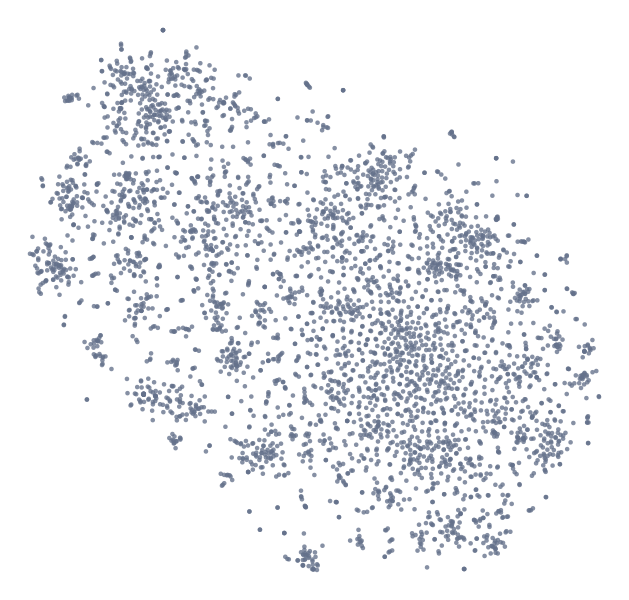 Drag to pan · + / − to zoom
OpenAI’s plugin ecosystem is expanding across products. It introduced plugin support in Codex in March 2026; its current documentation describes one public directory shared by ChatGPT and Codex. This makes an integration available through more places where people already work.
Our September snapshot contains 4,142 app and connector records. The map above groups their descriptions by semantic similarity, showing where integrations describe overlapping jobs. It does not tell us whether those integrations work equally well, attract users or earn revenue. Nor does one snapshot establish how quickly the catalog is growing.
When does a directory become a marketplace?
The terminology can obscure the question. OpenAI’s developer documentation uses “marketplace” for a curated JSON catalog of plugins. That is a distribution format. A mature marketplace, in the economic sense we mean here, needs evidence that relevant demand repeatedly reaches capable suppliers and gives them a reason to keep participating.
OpenAI’s own guidance shows some of the conditions still being worked out. Published plugins can be found through a direct link or name search, but few receive enhanced distribution at publication. Being listed does not guarantee being encountered.
Commerce is also bounded. The current plugin guidelines permit commerce for physical goods, prohibit selling digital products or subscriptions through plugins, and allow access through existing paid accounts. External checkout is the standard approach; integrated checkout remains limited to selected partners. These are meaningful commercial constraints, even when an integration has useful functionality.
The direction is clearer than the outcome
Our reading is that OpenAI is building the conditions for a marketplace. We would not yet treat directory scale as proof that a mature one has emerged. That is an assessment of the available evidence, not a claim that plugins generate no value today.
The next useful evidence would be whether users return, whether appropriate integrations reliably receive and complete requests, and whether publishers see enough value to maintain them. The directory could become a substantial distribution and commerce channel, or remain primarily a connection layer for services people already use. Its present size cannot settle that question.
For builders, publishing is a starting point. The harder question is whether an integration is found for the right task and delivers an outcome worth returning for.
- Snapshot
- September 25, 2026. 4,142 OpenAI-sourced app and connector records; 17 delisted records excluded. This is our collection, not an official total or a census of every plugin type.
- Similarity
- Description only; text-embedding-3-small, 1,536 dimensions. Neighbors use cosine similarity in the original vector space. Names, tools and categories do not affect the score.
- Map
- t-SNE on cosine distances; perplexity 40, seed 42, 1,200 iterations. Positions are approximate. Category labels are missing for 2,419 of 4,142 records.
- Limits
- A single snapshot cannot estimate catalog growth. We measured no installs, live tool success, user retention, transactions or publisher revenue. Official documentation checked September 26, 2026.
Results are directional simulations, never predictions.
Get the next report.
One email when there is something measured to report.